The Romantic Claim
I might just be a romantic, but I firmly believe branding is the closest designers can come to fulfilling our real roles. Storytellers. Wizards. Heroes. Or actors. Artists. Jesters. Whichever designer archetype you gravitate toward, real storytellers know branding is the final frontier of design. Every day you distill culture, data, knowledge, wisdom, talent, and intuition into meaning made from basic forms.
Every branding project is a new challenge and a new opportunity to immerse yourself in a new way of looking at the world. Then push the world a half step toward a more ideal version of itself.
Meaningful Design
Beyond the standard UX and UI whines and cries of “empathy”, branding is where design actually means something. A brand has to be meaningful, and it has to connect with the customer close enough to be trusted to help them grow.
Why Brand Designers Are Set Up for the AI Era
The AI era is going to favor real stories and real people. The teams that thrive in agentic design will not be the ones with the longest UX flowcharts. They will be the ones who can distill a messy world into coherent systems, then keep those systems evolving as the world keeps moving.
That is the job description of a brand designer. Curiosity as method. Interdisciplinary thinking as baseline. Strategic storytelling as daily practice.
Boutique studios and solo practitioners are not behind in the agentic shift. They are uniquely set up for it. Less ceremony, tighter loop, more time on the work itself. The brand IS the product the studio ships every week.
What I Mean by Agentic Branding
When I say agentic branding I mean a few specific things.
The archive becomes infrastructure. A studio’s history of decisions, drafts, voice notes, sketches, client work, press, photos, and writing stops being a portfolio kept for posterity and starts being a source the studio actually pulls from. The brand learns from its own history because that history is finally somewhere the next piece of work can read it.
The voice keeps moving. A static brand book ships once and rots between launches. An agentic brand lives inside the work and moves forward with it. The studio still makes the calls about voice and direction. The brand is just present everywhere it needs to be, in the right form, all the time.
The customer is reminded, in context. A brand stops needing to introduce itself every time it shows up. The customer does not have to relearn who you are at every new touchpoint. They are reminded, gently and consistently, why they trusted you in the first place.
Continuity, memory, and pattern matching are what AI is actually good at, and brand designers are already the people whose job is to know what to remember and what to leave out.
What We Are Building at Workhorse
This is not theory. We are mid-build on a brand operating system for living brands. The current draft of the Workhorse marketing site is the argument made out loud.
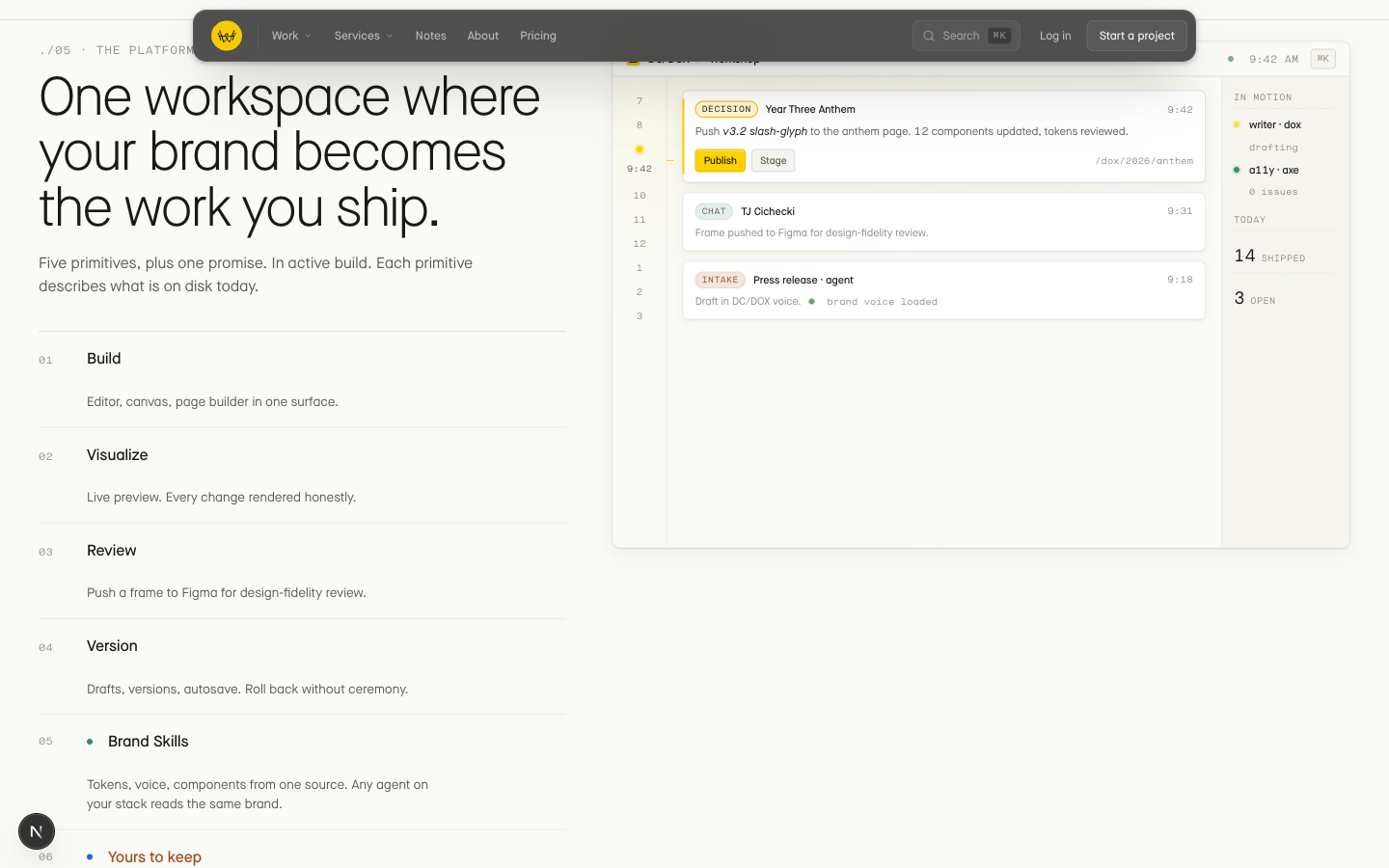
./05 of the home page. “One workspace where your brand becomes the work you ship.” Five primitives plus one promise. The Brand Skills primitive, lit, reads: tokens, voice, components from one source. Any agent on your stack reads the same brand.
The platform brings the brand and the work into the same workspace. Where most teams treat a brand as something handed over once and then referenced from a separate file, here it is the live source that the designer, the editor, the reviewer, and the agent on the stack all read from at once. The studio stays on the work between launches because the brand stays alive between launches.
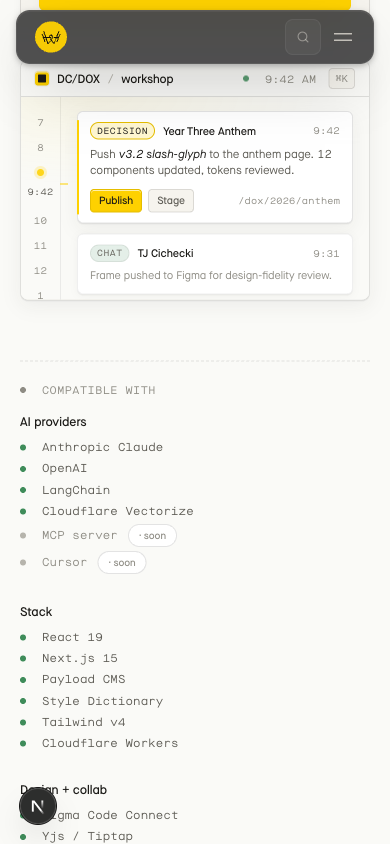
Same platform surface, mobile container. The activity feed keeps running: a decision queued on the year three anthem, a frame pushed to Figma, a press release drafting in DC/DOX voice.
The activity feed is the part I want every brand designer to look at. A decision queued on a campaign anthem, a frame pushed to Figma for review, a press release drafting in the right voice. All of it moving through one stream because everything reads from the same brand. A brand stops being a deck handed off at the end of a project and starts behaving like the living source running through every surface where it shows up.
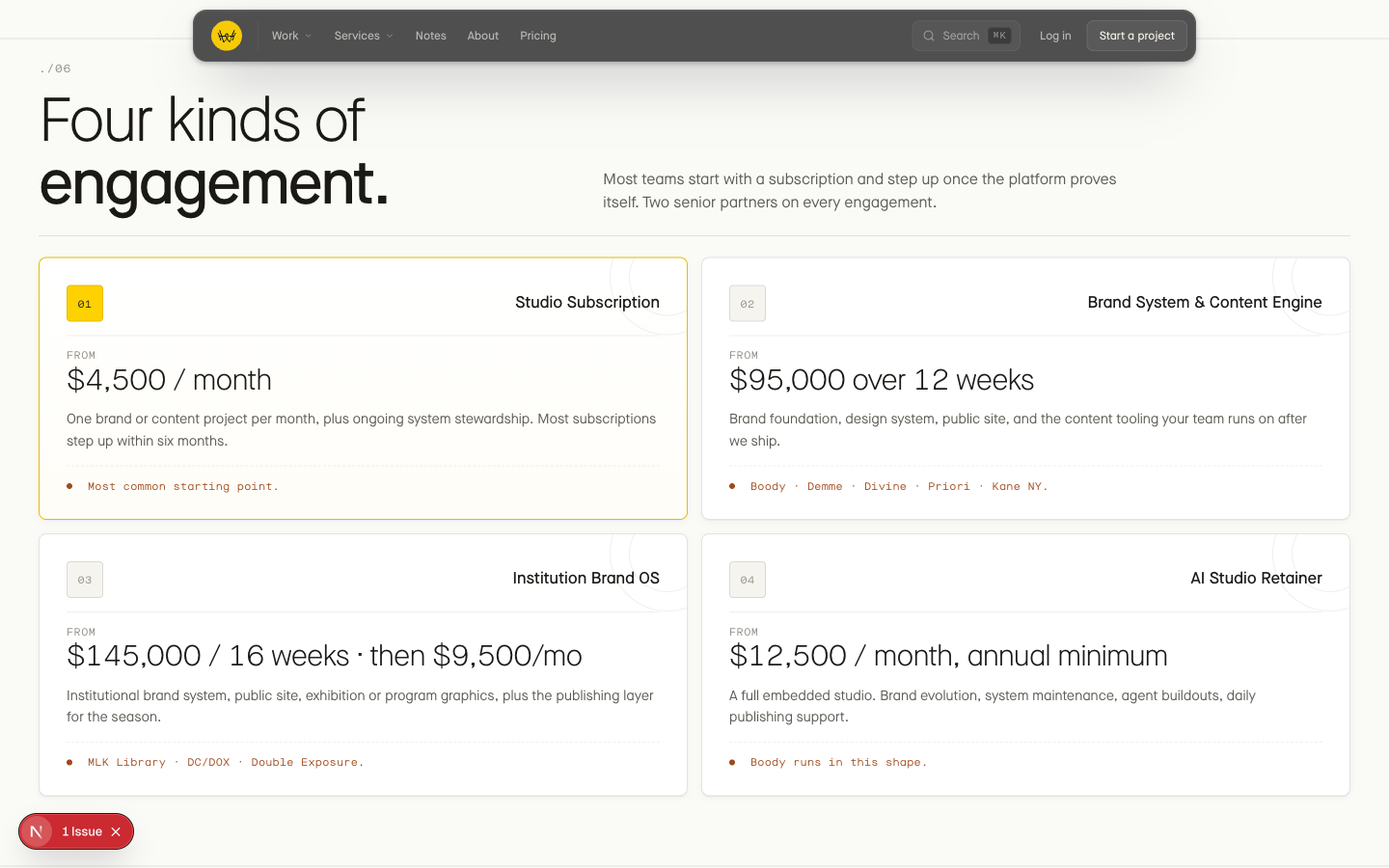
./06. Four kinds of engagement. Studio Subscription. Brand System and Content Engine. Institution Brand OS. AI Studio Retainer. Two senior partners on every engagement.
The engagement model is shaped so the studio stays small and the platform does the scaling. The relationship with a client is a long-running embed rather than a project handoff, because the platform is built to keep the brand evolving long after a launch.
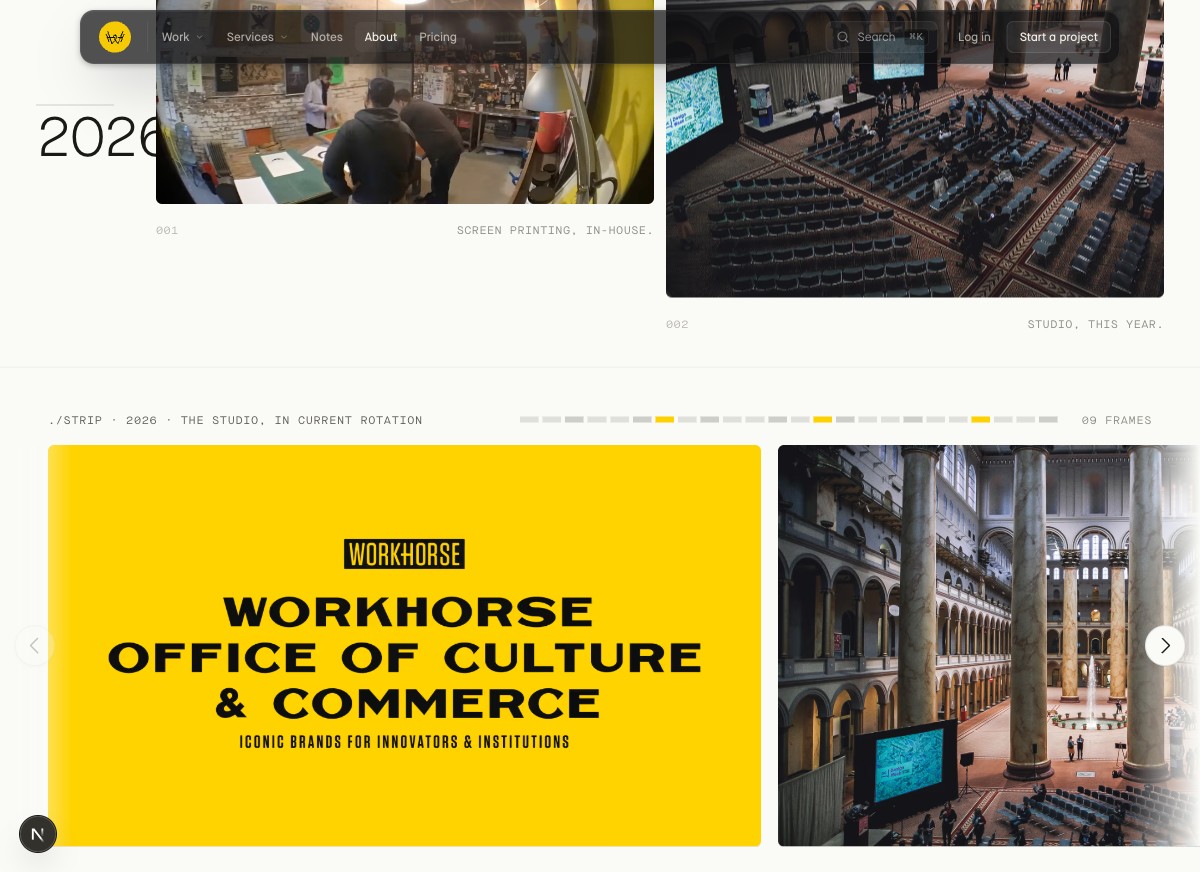
From the about page rebuild. The studio’s twelve-year history rendered as an era spine. Each era a chapter in the same evolving brand.
The about page is the proof. A studio’s own history, rendered as the kind of self-evolving archive we build for clients. The brand learning from itself before we ask anyone else to trust the same approach with theirs.
Agentic Publishing
The same architecture that keeps a brand alive between launches keeps a publication alive between issues.
A small media operation, an editorial studio, or an independent writer with a list. Each of them spends most of their time today renting tools from someone else. Substack for the relationship, MailChimp for the list, Google Analytics for the read, X or LinkedIn for distribution, a separate CMS or design tool for the look. The writer pays a stack of platforms for the privilege of doing their own work and gets back none of the data that compounds.
The next era hands the stack back. The site is the publishing tool. The archive of everything you have written is the corpus the next piece pulls from. An agent that has actually read your back catalog can draft in a voice you recognize, fact-check against what you have already published, and remind a reader why they came in the first place. The publisher keeps the relationship, the data, the voice, and the leverage. The blog era returns, with the tools writers and small publishers have been waiting for actually arriving.
This is the same logic as the rest of the post. A brand and a publication are both voices that compound. They both have an archive that does most of the work, if the archive is somewhere the next piece can read it. They both want a studio or a writer staying on the work between launches, not handing the brand off to a calendar.
For a studio or a small media operation, this is how the team stays the size you actually want while the work you publish keeps growing. For an independent writer leaving a hosted platform, this is what it looks like to own the whole loop. For a designer thinking about content systems, this is what it looks like when the publishing system reads from the same brand source the rest of the work does.
What this returns to the publisher is the editor’s chair, with the algorithm and the platform layers pushed back to where they belong.
The Final Frontier Moved Closer
Branding remains the final frontier of design, regardless of how much of the tooling around it changes.
The brand designer’s job is still to distill culture, data, knowledge, wisdom, talent, and intuition into meaning made from basic forms. Agentic tooling just makes that loop tighter and more honest, with the studio staying on the work and the brand staying alive between launches.
If you are a brand designer, a writer, or a small publisher reading this and wondering whether your discipline is going to matter in the next five years, it is going to matter more than ever. Bring your curiosity. Bring your archive. Bring the stories you have already learned to tell.
Branding and publishing are both moving into agentic tooling, and the people who already know what to remember are the ones who get to shape what they become. I’ve made this argument before, from different angles, in Branding and the Truth and Vibe Coding is Design.